Open Source Becomes China's AI Deployment Shortcut
The open-model race is not only about who publishes better weights. It is about who can turn constrained hardware, local installers, and public code into working systems fastest.

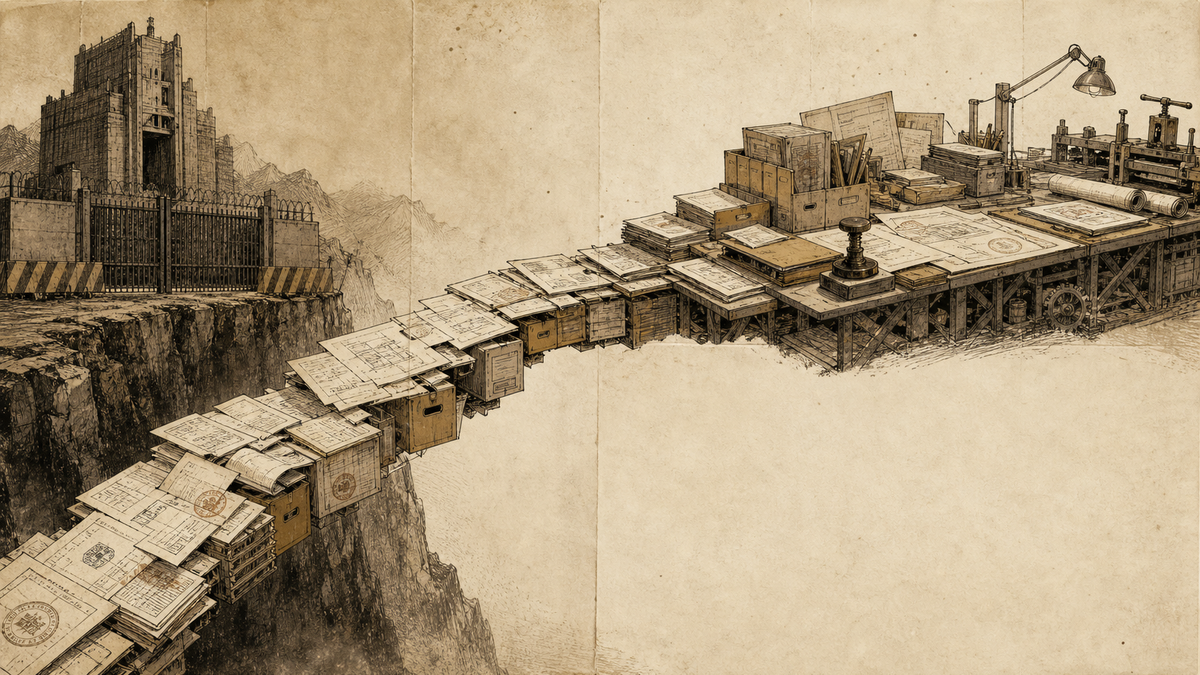
China’s most important open-source AI move is not that it makes models available. It is that availability changes the route by which AI enters the real economy. A closed frontier model has to sell access, compliance, uptime, trust, and vendor dependence before it becomes infrastructure. An open model can move through engineers, local vendors, universities, state-backed labs, manufacturers, and system integrators before any single platform has won the trust argument. That is the uncomfortable part. Open weights do not remove control from the system. They relocate it.
The shortcut is distribution, not generosity
The easy story is that Chinese AI labs are embracing openness because they need a cheaper answer to OpenAI. That is partly true, but too small. The stronger reading is that open release turns capability into a distribution system.
Tiezhen Wang’s argument in Rest of World matters because it treats China’s open-source AI push less as a moral posture than as a competitive tactic. If a model can be downloaded, inspected, fine-tuned, distilled, hosted locally, and wrapped inside existing software, the bottleneck shifts. The winning question is no longer only who has the best model. It becomes who can get a good-enough model into the most workflows with the least institutional friction.
That distinction is the whole piece. Proprietary labs try to make trust centralized: trust us with your data, your developers, your roadmap, your uptime, your compliance posture. Open models make trust more modular. The installer, reseller, cloud provider, factory IT team, or government contractor can say: trust the implementation we control.
This is why “open source” is the wrong emotional frame. The practical frame is deployment surface. Public weights create more hands that can carry the model into more places, including places where a foreign API would never be approved.
Export controls make openness more useful
The mainstream policy reading says hardware restrictions slow China’s AI frontier by limiting access to the best chips. That reading is not wrong. It is incomplete.
Compute controls push Chinese AI strategy toward software routes that waste less central permission. If frontier training becomes harder, then model reuse, distillation, optimization, local adaptation, and deployment discipline become more valuable. The constraint does not make openness inevitable, but it makes openness useful. It turns every released model into a base layer that others can stretch.
That is the connection to the hardware border I traced in Chip Leverage Is the New AI Border: chip access is not just a supply problem; it changes the shape of software strategy around it. When the most advanced hardware becomes politically restricted, the actors downstream stop waiting for perfect frontier access. They route around it with whatever can be copied, compressed, hosted, and modified.
DeepSeek-R1 showed why this matters. Its paper on reasoning via reinforcement learning did not merely announce performance; it supplied a technical reference point that other teams could study and reproduce. The public DeepSeek-R1 repository made the release operational rather than symbolic: weights, implementation details, and developer-facing materials became part of the distribution mechanism.
Export controls may still slow the most expensive training runs. But they also raise the value of every capable model that can circulate without asking a proprietary gatekeeper for permission. The control regime narrows one path and unintentionally sharpens another.
Trust moves from the model owner to the installer
Closed AI companies sell a promise: the model owner is the trust anchor. The customer does not need to understand the system deeply because the vendor claims responsibility for reliability, security, compliance, and improvement. That works best when buyers believe the vendor’s centralization lowers their risk.
Open models invert the sales motion. They do not ask every buyer to trust the original lab in the same way. They allow trust to be rebuilt closer to the use case.
A hospital, manufacturer, school district, municipal agency, or logistics firm may not want a foreign black-box API sitting inside sensitive workflows. But it may accept a locally hosted model packaged by a domestic cloud provider, tuned by a trusted integrator, and constrained by internal rules. The model’s origin still matters. Yet the immediate relationship is with the party installing and maintaining it.
The Hugging Face distribution page makes that visible. The model is not only a Chinese artifact moving through Chinese channels. It is part of a global software distribution fabric where developers can pull, test, fork, quantize, benchmark, and adapt. Once a model enters that fabric, its influence is no longer limited to the institution that produced it.
This is also why software supply chains become political infrastructure. In Software Supply Chains Are Becoming AI’s Hidden Permission Layer, the point was that control increasingly lives in registries, dependencies, provenance, packaging, and update paths. Open AI models intensify that pattern. The visible contest is model capability. The quieter contest is who controls the routes through which models become dependable software.
The proprietary moat becomes an integration race
The proprietary response is not doomed. It is changing. If open models compress the distance between capability and deployment, then closed labs have to compete somewhere other than raw intelligence alone.
That is why partner networks matter. OpenAI, Anthropic, Google, Microsoft, and others are not only selling models; they are selling integration with enterprise software, identity systems, developer tools, compliance processes, and procurement comfort. As I argued in OpenAI’s Partner Network Makes Integration the Moat, the moat is increasingly the system around the model, not the model in isolation.
China’s open-model strategy pressures that moat from underneath. A proprietary platform can be more polished, better supported, and safer for certain enterprise buyers. But an open model can appear inside the local product before procurement has finished comparing frontier benchmarks. It can be embedded in a factory dashboard, a customer-service tool, a coding assistant, a municipal document system, or a small-business sales workflow without waiting for a single dominant vendor to bless the use case.
The Stanford HAI 2026 AI Index gives the broader backdrop: capability is diffusing, costs are shifting, and industry concentration sits beside widening access to powerful tools. That combination is unstable. When capability spreads faster than institutional trust, the advantage moves to whoever can make adoption feel ordinary.
For builders, this means the model layer is becoming less sacred. The practical edge is packaging, evaluation, workflow fit, data boundaries, support, and deployment speed. For investors, it means “owns the model” is a weaker thesis than “owns the channel where the model becomes useful.” For states, it means restricting chips does not settle the software distribution problem.
The test is where the models get embedded
The decisive question is not whether open-source Chinese models can “beat OpenAI” in some clean, universal sense. That question is too attached to the leaderboard imagination of AI. The better question is where these models become hard to remove.
A model that wins a benchmark can still fail to become infrastructure. A slightly weaker model that gets embedded into procurement systems, developer templates, local clouds, industrial software, education tools, and government workflows may matter more. Deployment has memory. Once an organization builds around a model family, trains staff on it, wraps governance around it, and connects it to internal data, replacement becomes expensive.
This is the hidden force in China’s open-source push. It does not require the world to conclude that Chinese models are philosophically more open, technically supreme, or politically neutral. It only requires enough actors to find them available, adaptable, and locally controllable at the moment they need something deployable.
That should unsettle both sides of the usual argument. Openness is not automatically liberalizing. Control is not automatically centralized. The same public weights that let a startup move faster can also let a state-aligned industrial system spread faster. The same release that looks like generosity from the outside can function as infrastructure from within.
The next AI border will not be drawn only around chips, labs, or national champions. It will be drawn around installation paths. Ask less often who owns the smartest model. Ask who is allowed to make it boring.