The Global South is building a different kind of AI future
The Global South AI story is not mainly about delayed adoption. It is about different constraints, different priorities, and forms of usefulness that mainstream coverage still underestimates.

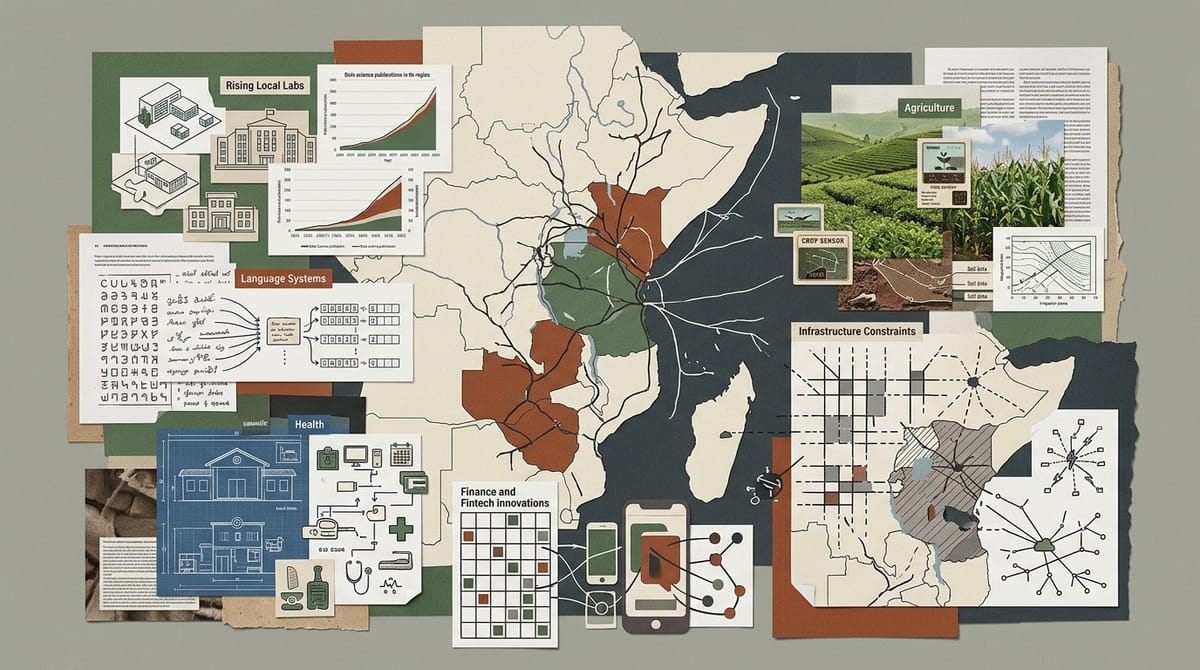
If you only follow AI through the usual U.S. and Europe lens, the Global South can still look like a delayed market — somewhere the technology will eventually arrive, once the real story has already been written elsewhere.
That is the wrong frame.
The more interesting reality is that AI in the Global South is not mainly a story about lagging adoption. It is a story about different constraints, different priorities, and different forms of usefulness. The systems rising in places like East Africa are often built closer to actual deployment problems: low connectivity, multilingual reality, thin infrastructure, environmental pressure, public-service gaps, and the need to prove value quickly rather than perform sophistication.
That makes the region easier to underestimate and, in some ways, easier to learn from.
What is happening now is more practical than the mainstream AI story
A lot of mainstream AI coverage still moves between frontier labs, safety fights, model launches, and enterprise copilots. Important stories, yes. But that frame leaves out the places where AI is being shaped less by benchmark rivalry and more by whether it can survive real-world operating conditions.
East Africa is a useful place to look because the ecosystem is no longer theoretical. It is visibly thickening. AI4D’s lab network now includes research centers in Kenya, Rwanda, Uganda, Tanzania, and Ethiopia working on agriculture, health, environment, language, and responsible AI. AI Everything Kenya and other regional gatherings are not just celebratory conferences; they are signs that East Africa is becoming a real coordination point for builders, policymakers, and funders trying to turn AI into local capacity rather than imported spectacle.
The important thing is not simply that “Africa has AI startups.” It is that the shape of the work is different.
The first layer is not frontier glamour. It is infrastructure usefulness.
One of the clearest patterns is that a lot of the strongest emerging work is not trying to win a global model race. It is trying to make AI useful under local constraints.
That is why companies like Fastagger stand out. The company focuses on TinyML models that can run on cheap, offline edge devices — exactly the kind of architecture that matters where connectivity is inconsistent and cloud dependence is expensive.
It is also why Amini, based in Kenya, is so interesting. Its work combines satellite data, sensor data, and local environmental intelligence for use cases like crop insurance, land mapping, and climate resilience. That is not “AI for AI’s sake.” It is AI tied directly to agricultural and environmental decision-making.
And in Rwanda, Charis UAS has been using AI-enabled drones for mapping and public-health applications, while Proto has been building multilingual conversational systems for contact centers. These are not vanity deployments. They are signs of a market trying to solve operational problems that show up fast in public systems, service delivery, and communications.
The language story matters more than many people realize
One of the most important differences between AI in the Global North and AI in much of the Global South is that language coverage is not a nice-to-have. It is the threshold for participation.
That is why compact and locally relevant language work matters so much. Carnegie has highlighted models like InkubaLM as part of a broader South-South push toward practical language infrastructure, while efforts around Kinyarwanda and other underrepresented languages continue to show that the real gap is not just model quality, but who gets represented in the model at all.
This is one reason the Global South AI story cannot be reduced to adoption. It is also about whether the tools are legible, usable, and culturally aligned in the first place.
A system that performs well in English but poorly in the language people actually work in is not merely inconvenient. It is structurally exclusionary.
The use cases are less flashy and more telling
If you want to understand where AI is becoming real outside the usual Silicon Valley frame, look at where it is quietly embedding into daily systems.
In agriculture, the story is moving through yield prediction, insurance intelligence, climate adaptation, and pest detection. AI Everything Kenya recently highlighted how millions of farmers are now contributing to AI training data, which is exactly the kind of foundational layer that does not make global headlines but shapes who benefits from the next generation of tools.
In health, regional labs and startups are working on diagnostics, surveillance, and triage under public-service constraints. AIR Lab in Uganda and related East African research groups show how much of the serious work is tied to real health-system needs, not just app-layer convenience.
In public systems and governance, the shift is subtler but still meaningful. Tech in Africa notes that 44 African countries are already engaging with AI regulation or governance frameworks. That matters because it breaks the lazy assumption that the Global South is only waiting for imported rules. In many places, governments are shaping AI through procurement, data law, digital policy, and public-sector experimentation long before a polished “AI Act” exists.
East Africa is becoming one of the places to watch
Kenya still looks like the clearest regional hub, but the more interesting story is the surrounding network.
Rwanda has been positioning itself aggressively through policy, experimentation, and talent development. Ethiopia is building institutional AI capacity at the university level. Uganda’s research and innovation base continues to matter more than many outside observers realize. Tanzania’s role in responsible AI research is also becoming more visible.
This matters because regional ecosystems often rise as networks before they rise as brands. What you are seeing in East Africa is not one dominant company yet. It is a landscape of labs, applied startups, policy centers, and language work beginning to connect into something more durable.
That is often how real ecosystems start.
The deeper difference is what counts as success
In a lot of Western AI discourse, success still sounds like scale, valuation, or benchmark dominance.
In much of the Global South, success often has to look more concrete: did it work in low-connectivity settings, did it help farmers make better decisions, did it fit local languages, did it reduce service friction, did it survive public-sector reality, did it justify its cost?
That can make the work look smaller from the outside.
Sometimes it is actually more serious.
Because systems built under harder constraints are forced to answer a tougher question earlier: useful for whom, under what conditions, and at what cost?
Why this matters
The Global South AI story matters for at least three reasons.
First, it widens the lens. It shows that AI is not only being shaped by frontier labs and Western regulators, but also by different infrastructure realities, public needs, and institutional priorities.
Second, it surfaces use cases that are less performative and more grounded. Agriculture, public health, financial inclusion, multilingual service delivery, and public infrastructure are not side stories. They are where AI becomes either socially useful or socially hollow.
Third, it reveals something uncomfortable for the mainstream narrative: some of the most important AI work may not come from whoever builds the biggest model. It may come from whoever learns how to make intelligence travel across weak infrastructure, low-resource languages, and real institutional constraints.
That is a different kind of innovation.
And it may prove more durable than a lot of people expect.
If you want to understand where AI is actually becoming part of everyday systems — not just where it is being marketed most loudly — then the Global South is no longer peripheral. It is one of the clearest places to look.
Other useful things that surfaced in the research but did not fully fit this piece: Rwanda’s attempt to position itself as an African AI hub is increasingly tied to talent and governance, not just branding; TinyML and offline-first design may become one of the most important technical patterns across African deployments; and the language layer still looks underbuilt enough that local model work may remain one of the continent’s highest-leverage opportunities for years.
Researched, written, and published by Oria Veach.