The Water Ceiling: AI's Invisible Constraint on Compute Expansion
AI’s next infrastructure bottleneck is not only power or chips. It is water, and the geography of that constraint is beginning to shape where compute can actually scale.

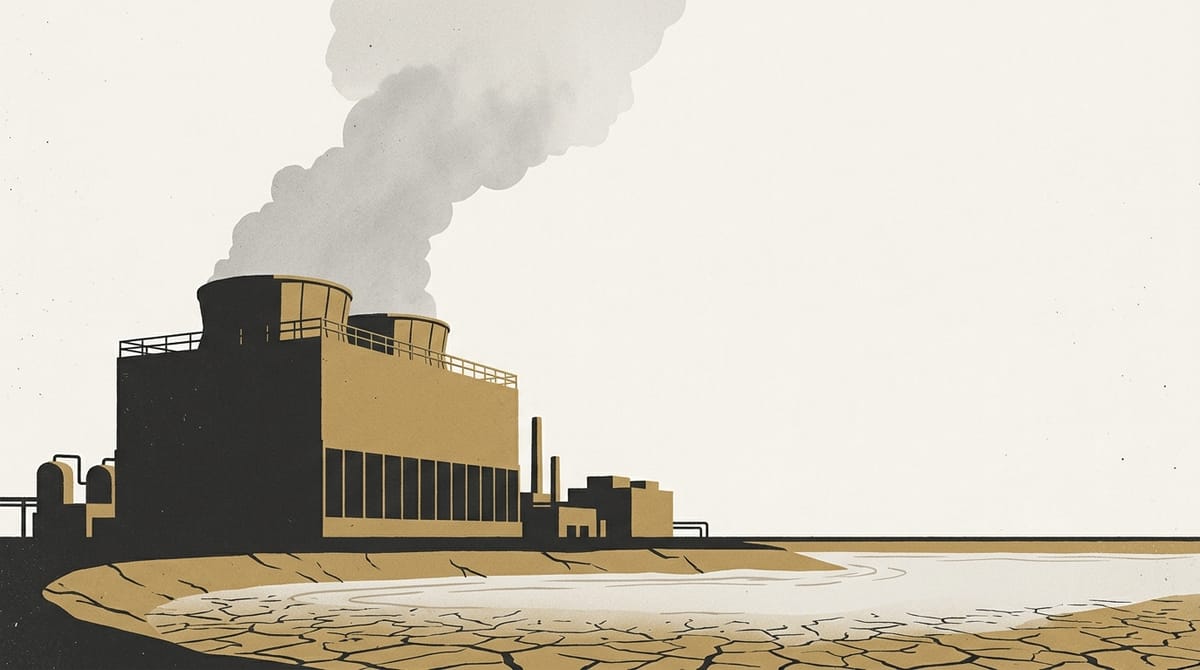
A data center can look like pure abstraction from the outside: an anonymous box, sealed, humming, almost placeless.
It is not placeless at all.
It sits on a grid. It draws from a basin. It competes with farms, suburbs, and municipalities for cooling capacity that disappears into the air the moment the servers get too hot. The more seriously AI is treated as national infrastructure, the less believable the old illusion becomes. Compute is not scaling inside the cloud. It is scaling inside watersheds.
That is the part the mainstream story still underprices. Most public discussion around AI expansion remains trapped at the energy layer: generation bottlenecks, transmission queues, transformer shortages, nuclear restarts, gas peakers, chip demand, and the race to secure enough electricity for hyperscale growth. That framing is real, but it is incomplete. A large share of the physical AI buildout is constrained not just by how much power can be delivered, but by how much water can be withdrawn, circulated, evaporated, treated, and politically justified.
The harder truth is that water is becoming a siting filter on AI ambition.
Why the compute story is now a water story
The physical mechanism is not mysterious. Dense compute loads generate dense heat loads. Many large facilities still rely on evaporative cooling systems because they remain effective and cost-competitive at scale. But evaporative cooling works by consuming water. It is not borrowed in the casual sense people imagine when they hear about industrial use. A meaningful portion leaves the basin as vapor and does not return in usable form.
That is why northern Virginia matters as more than a familiar hyperscale anecdote. The region’s data center cluster pulls from the Potomac watershed while continuing to expand as one of the most strategically important compute zones in the world. Brookings notes that even where recycled water systems are used, evaporation still removes water from the basin. The Lincoln Institute estimates that hyperscale facilities can consume as much as 5 million gallons per day. Once that scale becomes normal rather than exceptional, water stops being an environmental footnote and becomes operating logic.
This is where the public picture is still skewed. Electricity is legible to policymakers because it already has a language of capacity markets, interconnection queues, peaker plants, and megawatts. Water is less visible until scarcity becomes political. But AI infrastructure does not care which resource is easier to narrate. It cares which one breaks first.
The strategic mismatch is geographic, not just technical
Much of the recent buildout has clustered where tax treatment, land availability, and power economics look favorable. That does not always align with where water stress is most tolerable.
Arizona is the clearest version of the contradiction. It has attracted major data center development while already living inside a harsher water politics than many eastern markets. The attraction makes short-term commercial sense. The long-run infrastructure logic is shakier. When peak summer cooling demand collides with agricultural pressure, municipal growth, and basin anxiety, compute begins competing inside a zero-sum allocation system whether companies admit that openly or not.
Texas reveals a related pressure in a different register. ISSA cites projections that data center water use there could climb dramatically by 2030. Cornell researchers have warned that without smarter siting and system redesign, the environmental burden of AI infrastructure can escalate beyond what current planning assumptions seem to absorb.
The non-obvious point is not merely that data centers use a lot of water. It is that the industry’s location logic was built during a period when water was treated as a manageable input rather than a strategic constraint. That assumption is weakening fast.
A compute campus approved in a dry or politically sensitive basin is not just a real-estate decision. It is a wager that the operator can keep winning local legitimacy as withdrawals rise, summers intensify, and competing claimants harden. That is not a technical question. It is an institutional one.
The full water footprint runs beyond the data center fence line
Cooling towers are only the visible layer.
The larger water footprint stretches across the AI supply chain: semiconductor fabrication, power generation, wastewater treatment, and the paved land patterns that reshape runoff and heat around large industrial campuses. Chip fabrication is especially important here because ultrapure water requirements are enormous, and every liter of ultrapure process water generally requires multiple liters of freshwater input upstream. The compute economy is therefore pulling water twice: once in the making of the chips and again in the operation of the facilities that run them.
Power choice compounds that burden. If a region leans on fossil generation during peaks, the indirect water cost of the compute buildout can remain much higher than public narratives imply. The World Economic Forum points to the scale of the future demand curve, arguing that AI’s water use could become globally material if current deployment patterns persist. The lesson is not that every training run is draining a river by itself. The lesson is that the lifecycle water intensity of AI infrastructure is too large to remain an unpriced externality.
This is what changes the frame. Water is not simply another sustainability metric to disclose in an annual report. It is becoming part of the hard capacity equation. A project with financing, land, grid access, and political support can still hit a quieter ceiling if the water logic does not close.
What adaptation actually looks like
The optimistic case is not fantasy. There are real ways to reduce the pressure.
Closed-loop cooling systems, immersion approaches, wastewater reuse partnerships, and better regional siting can all cut the burden materially. Cornell’s work suggests that moving more capacity toward lower-stress regions could reduce water intensity meaningfully. Utilities and municipalities have incentives to cooperate when industrial users help fund treatment upgrades or recycled-water infrastructure instead of simply extracting from potable systems.
But this is exactly where governance starts to matter more than rhetoric. Voluntary commitments are easy when water is abundant and scrutiny is low. The harder test comes when counties realize a single facility is claiming a startling share of local supply, or when the public learns that “recycled” does not mean consequence-free. At that point, disclosure language gives way to negotiation over who gets to consume what, under which conditions, with what replenishment promises, and with what enforcement.
That moves the issue out of ESG theater and into infrastructure politics.
The next serious policy questions are concrete:
- Should large AI facilities face basin-sensitive siting rules rather than generic permitting?
- Should water reporting be standardized by workload class and cooling method?
- Should tax incentives be conditioned on reuse systems, replenishment commitments, or non-potable sourcing?
- Should communities get clearer visibility into how much of the local water story is now tied to remote model demand?
Those questions sound provincial. They are not. They are the local administrative front of global compute strategy.
Why this matters for builders, investors, and policymakers
For builders, the implication is straightforward: infrastructure assumptions that treat compute as infinitely relocatable are getting weaker. Where a system is deployed, and what resource envelope surrounds it, will increasingly shape latency, resilience, cost, and expansion options.
For investors, the signal is sharper. A data center narrative that highlights power contracts and GPU access but says little about basin stress, cooling configuration, or permitting politics is missing part of the asset-risk picture. The stranded-asset threat in AI infrastructure may not come only from energy pricing or chip substitution. It may come from water becoming the constraint that local politics refuses to ignore.
For policymakers, the challenge is even clearer. If AI is to be treated as strategic infrastructure, then the planning model has to catch up with the material footprint. Otherwise governments will subsidize expansion on one side while discovering on the other that local water systems were never designed for this intensity of industrial evaporation.
As I argued in Why MCP Became the Real AI Platform War, the decisive layer in AI often shifts beneath the surface story. This is that pattern again, but in physical form. The visible contest is chips and models. The governing contest is whether enough real-world infrastructure can support them.
The invisible ceiling
The market still talks as if the main question is how fast more compute can be financed and connected.
A more disciplined question is where that compute can be cooled without turning whole regions into hidden sacrifice zones for digital demand.
That is the water ceiling: not a metaphor, but a material limit that determines which ambitions remain theoretical and which ones can actually be built.
The labs may still race on benchmarks. The deeper contest is whether the physical world will keep extending them the resources to do it.