The Next AI Power Center Is the Factory, Not the Chatbot
The flashy AI race is becoming a sideshow. The harder and more consequential contest is over who can make machine intelligence admissible inside factories, supply chains, and engineering systems that cannot afford improvisation.

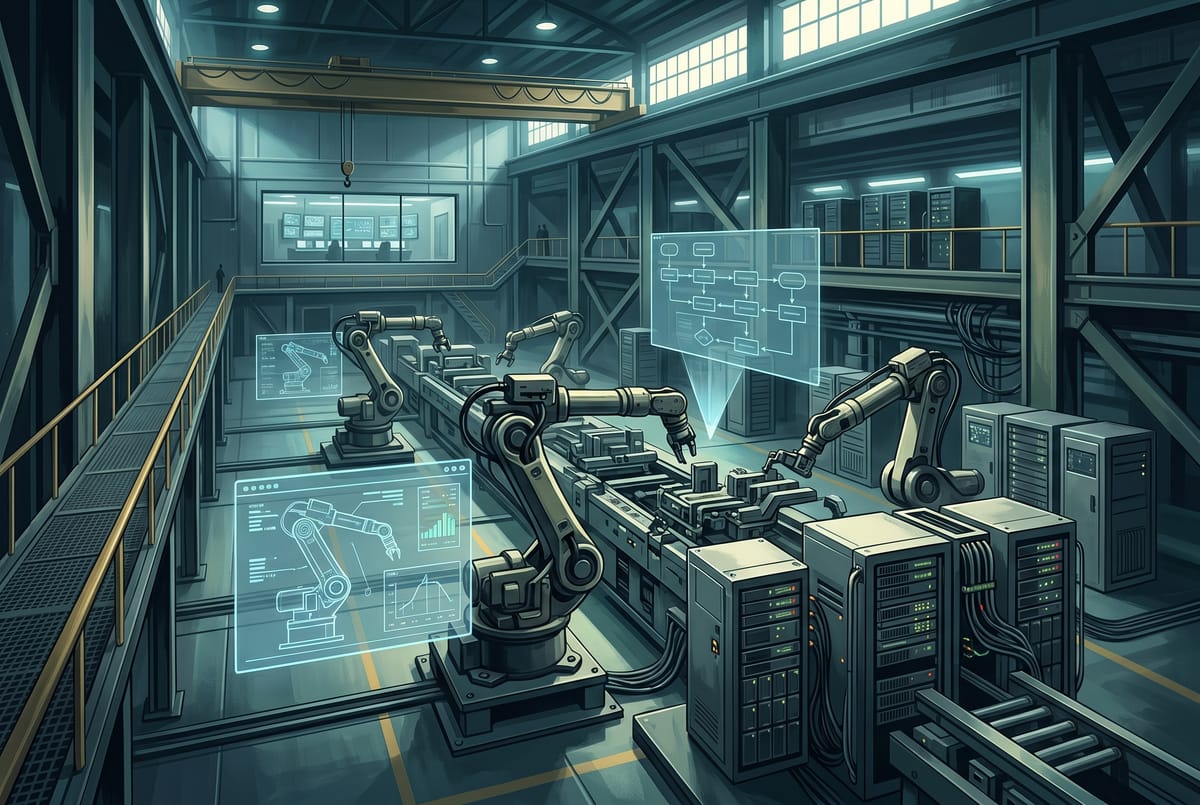
The center of gravity in AI is starting to move away from the browser tab. The next durable advantage will not come from who ships the smartest general-purpose chatbot. It will come from who can insert AI into factories, engineering systems, and supply chains where downtime has a cost center, traceability has an auditor, and every wrong action can break a physical process rather than merely annoy a knowledge worker.
Why this matters now
The evidence is increasingly hard to ignore. Stanford’s 2026 AI Index shows frontier capability still accelerating, but it also shows something more important: AI has become an economic and institutional contest, not just a model-performance race. At the same time, Hannover Messe 2026 has turned into a live demonstration of where the next battleground is likely to sit. Siemens is framing industrial AI as a competitiveness and resilience issue, not a convenience feature. Microsoft is pitching local and sovereign AI execution on factory sites, along with procurement agents for supply-chain management. NVIDIA is pushing “physical AI” through robotics partnerships that tie models to motion, simulation, and deployment.
That shift matters because the consumer AI market and the enterprise copilots market are already showing the first signs of narrative saturation. Everyone can demo fluent text generation. Much fewer companies can make AI useful inside a production line or automation workflow where the output has to survive audits, outages, and warranty claims.
The mainstream frame is too software-native
The dominant AI story still assumes the prize is interface dominance: the assistant you open first, the model you subscribe to, the SaaS layer you route prompts through. That frame made sense when the marginal gain came from better reasoning, better latency, or lower inference cost. It makes less sense once AI starts entering settings where language is only the outer shell of the system.
In industrial environments, the real product is not the chatbot. The real product is the workflow that the model can safely enter. Siemens’ new Eigen Engineering Agent is notable for exactly this reason: the company is not presenting AI as generic assistance, but as a system that can plan and execute automation engineering tasks inside a defined industrial stack. Its Industrial Edge ecosystem updates push in the same direction, emphasizing air-gapped operation, certified security functions, bidirectional data flow, and decentralized deployment. Those are not the details of a software fad. They are the details of a control system trying to become AI-native without becoming reckless.
This is where the economic model changes. In the chatbot market, advantage often comes from distribution. In industrial AI, advantage comes from embedding. The moat is not audience capture. The moat is operational permission.
What the market is actually selecting for
Once AI moves into factories and supply chains, the sorting mechanism changes. The winners are less likely to be the firms with the most charismatic demos and more likely to be the firms that can satisfy a harder bundle of constraints: local deployment, system interoperability, cybersecurity certification, workflow traceability, simulation before execution, and domain-specific integration.
That bundle is why “industrial AI” is not just another vertical use case. It is a different test of what an AI company actually is. The World Economic Forum’s Future of Jobs Report 2025 frames technological change, geoeconomic fragmentation, and workforce disruption as intertwined forces. Hannover Messe is showing the same convergence in product form. AI in manufacturing is arriving just as Europe is worrying about competitiveness, labor shortages, supply-chain resilience, and energy constraints. That means every industrial AI deployment is being judged not only on productivity, but on sovereignty and reliability.
A useful way to think about this is that consumer AI is still optimizing for delight, while industrial AI is optimizing for admissibility. If a model writes a slightly wrong email, the damage is trivial. If it pushes a flawed engineering instruction into an automation stack, the damage becomes contractual, physical, and political. The signature sentence here is simple: in the next phase of AI, the decisive threshold will not be intelligence alone but whether intelligence can survive contact with a warranty.
Why this changes the geopolitics of AI
This also sharpens a broader pattern. AI competition is no longer just about who owns the best models or the deepest GPU clusters. It is about who can translate compute into institutional control over high-value workflows. That is why the factory matters. It is where software ambition collides with equipment lifecycles, safety systems, procurement rules, and labor realities.
That is also why the industrial turn connects directly to earlier infrastructure questions. If AI scaling is already constrained by steel, copper, and transformer lead times, then the next competitive layer is not abstract intelligence but the ability to deploy intelligence inside scarce physical systems. And if AI rivalry is already entangled with export controls and industrial policy, then industrial AI becomes one more arena where sovereignty stops being rhetoric and becomes architecture.
This is the part many software-centric narratives miss. Industrial AI does not just create new products. It redistributes power toward firms with installed bases in automation, simulation, controls, robotics, utilities, and industrial networking. The next AI incumbents may look less like pure software companies and more like the firms that already understand factories, engineering change orders, edge compute, and maintenance windows.
What builders and investors should notice
For builders, the lesson is that domain context is no longer a nice-to-have. It is the product. The more physical and regulated the environment, the less valuable generic intelligence becomes on its own. For investors, some of the most durable AI value may be created in companies that look unfashionably industrial: firms selling plant-data middleware, robotics simulation layers, edge security for industrial inference, or specialized agents that complete narrow engineering tasks under supervision.
The market spent the past two years asking which model would win. The better question now is which institutions will absorb AI deeply enough to make model choice secondary. The answer is increasingly visible: not the loudest app layer, but the places where software has to earn the right to touch matter. The factory is one of those places. Once AI proves it can survive there, the hierarchy of the industry may change faster than the chatbot race suggests.
Related reading
- For a related piece on the physical constraints underneath AI expansion: Half of AI's New Data Centers Can't Open — Because Steel and Copper Can't Keep Up
- For a related piece on the geopolitical structure behind AI competition: China's Open-Source Gambit: Closing the AI Gap Amid Export Controls