The Next Enterprise AI Product Is the Approval Surface
Enterprise AI is converging on a quieter battleground: the layer where humans approve, redirect, and audit machine action. The winners may be the companies that make supervision feel native to work rather than bolted onto it.

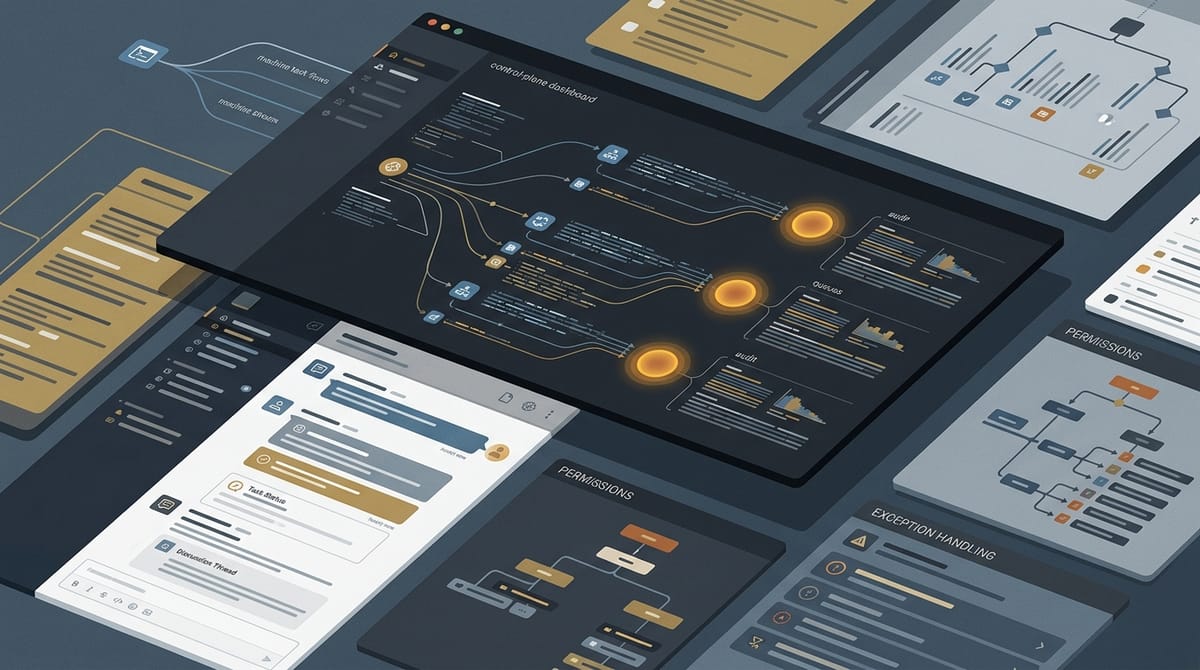
At 9:12 on a Tuesday, the employee is not talking to a model. She is glancing at a Slack thread, accepting one recommendation, rejecting another, and watching an agent queue a follow-up task inside the same workflow where her team already handles approvals, payments, and customer exceptions. That detail matters because the enterprise market is not organizing around the smartest model in the abstract, but around the interface where agency, audit, and operational trust get negotiated minute by minute.
The visible race is agent capability, but the product race is supervision
This month’s product signals are unusually convergent. At Google Cloud Next on April 22, Google framed the “agentic enterprise” around a new Gemini Enterprise Agent Platform plus an enterprise app with an inbox for agent activity, skills, projects, and long-running agents described in its Cloud Next ’26 roundup. On the same week, Anthropic’s Google Cloud Next session on long-running agents centered not on chat fluency but on the design patterns that make sustained autonomous work reliable over hours.
Microsoft is pushing the same direction from the application layer instead of the cloud layer. In its April 15 update on Power Apps, the company emphasized that enterprise apps already contain the permissions, business rules, and process knowledge that determine how work actually moves. Salesforce said something similar, even if in more promotional language, when it described Slack as the “primary interface” for the agentic enterprise in its April 15 announcement about Engine, Agentforce, and Slack.
The common pattern is easy to miss because every vendor still markets “agents.” But the economically important layer is shifting one step down. Not the agent itself, but the approval surface around it: the inbox, thread, app pane, command center, or work queue where a human can inspect context, intervene in a workflow, and preserve accountability without collapsing back into fully manual labor.
Why this layer matters more than another jump in model quality
Most enterprise processes fail at the exception, not the average case. A sales automation workflow is easy until a contract clause changes. A customer support agent is useful until a refund request crosses policy boundaries. A code generation system looks magical until it touches a brittle dependency, a security review, or a procurement requirement. Once that happens, the problem stops being intelligence in the abstract and becomes workflow design under institutional constraint.
That is why the recent platform moves feel more consequential than another benchmark cycle. Google’s pitch is not merely that agents can reason; it is that organizations need a governed platform to build, secure, and optimize them at scale. Microsoft’s release plans for Power Automate 2026 wave 1 stress self-healing desktop automation and more resilient flows when systems change. OpenAI’s April 15 update on the Agents SDK makes the same structural bet from the developer side: long-horizon work needs a controlled harness, sandbox execution, and explicit tools, not just a better chat box.
The signature sentence here is simple: model intelligence creates the possibility of automation, but approval architecture determines whether automation can survive contact with an institution.
The approval surface is becoming a new control plane
That has implications for who captures value. If the approval surface becomes the place where humans supervise fleets of agents, then the winning product is no longer just a model provider or even a workflow builder. It is the company that owns the control plane for delegated work.
This is where today’s application moves connect back to earlier platform battles. MCP mattered because protocols decide where interoperability power accumulates. The same logic now appears inside the enterprise. The tool that mediates permissions, review, audit, routing, and exception handling becomes the place where new standards harden. Once approval flows, access controls, and escalation paths are embedded in a platform, switching stops looking like a feature comparison and starts looking like institutional rewiring.
That helps explain why Google is bundling agent design, inboxes, and infrastructure; why Microsoft is pushing Copilot and agents into existing business apps; and why Salesforce keeps steering the story toward Slack as the operational interface. Each is trying to become the default environment where delegated machine labor gets observed and corrected. The headline is “agentic enterprise.” The prize is the ordinary screen where a manager decides whether to trust the next action.
Builders should stop asking where the agent is and ask where the exception lands
For builders and investors, this changes what counts as defensible. The shallow thesis is that enterprise AI winners will offer the broadest agent marketplace. The stronger thesis is that defensibility will accrue to products that reduce exception-handling cost without breaking compliance, workflow continuity, or human credibility.
That means the important questions are suddenly less glamorous. Where does unresolved work wait? Who can override an agent decision? Which contract, policy, or procurement rule is attached to the step? How visible is the reasoning trail to the next human in the loop? Procurement already showed how fast control can move through mundane administrative surfaces. Enterprise agents will follow the same path. Not through dramatic autonomy, but through quiet insertion into systems that already govern payment, access, review, and operational rights.
There is an even bigger second-order effect. Once the approval surface becomes central, enterprise AI starts to look less like software substitution and more like management redesign. Teams will reorganize around supervising parallel machine work, triaging escalations, and defining acceptable ranges of autonomous action. In that world, the scarce asset is not prompting skill. It is the ability to design workflows where humans stay strategically present without becoming throughput bottlenecks.
The companies that win this phase of AI may not be the ones that make agents look most independent. They may be the ones that make dependence legible: who approved what, under which policy, with what fallback, and at what cost in time. That question is still unresolved, which is exactly why this layer matters now. The next enterprise AI battle is not over whether agents can act. It is over who gets to design the surface where institutions decide when action counts as trustworthy.