How AI Is Repricing Africa’s Creative Economy
AI is lowering production costs across Africa’s creative industries, but the real economic question is whether creators gain bargaining power or platforms deepen their hold on the margin.

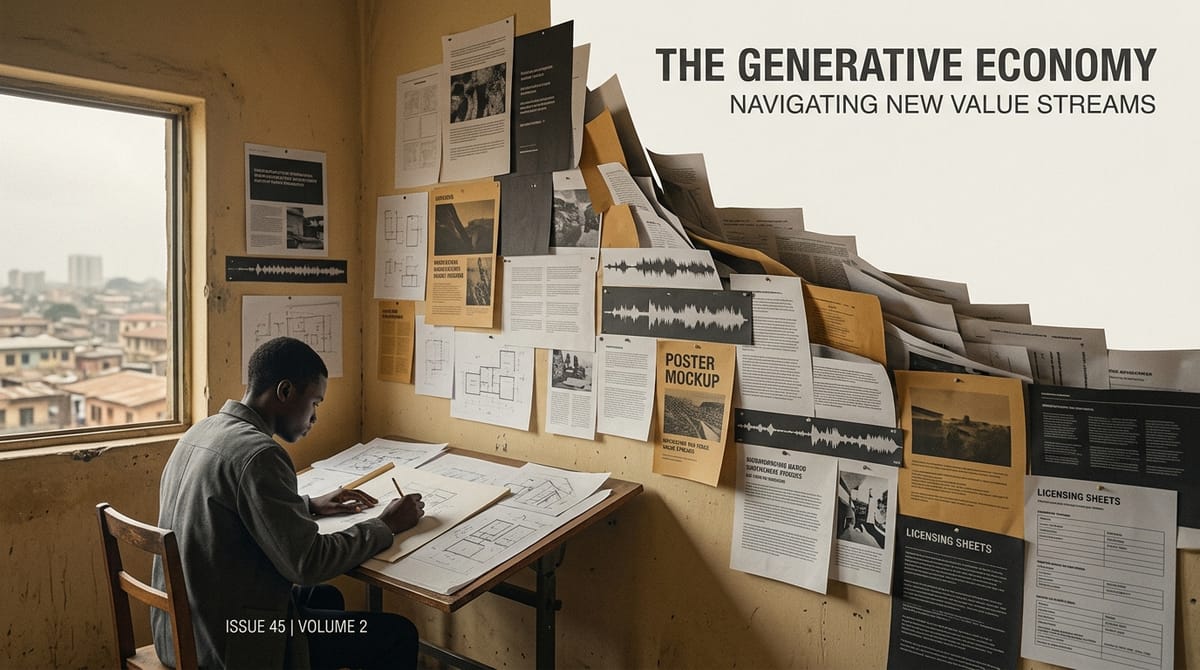
A designer in Nairobi can now draft campaign copy, subtitle short videos, and generate multiple visual directions in a single afternoon. A filmmaker in Johannesburg can clean audio, translate dialogue, and cut trailers with tools that would have required separate specialists a year ago. The obvious story is speed. The more important story is pricing.
Africa’s creative economy has always had a strange structure: abundant talent, global demand, and weak local bargaining power. Music travels. Fashion travels. Film travels. Design travels. But the money often does not stay where the work begins. AI enters that system like a lever. It can widen what independent creators are able to produce. It can also widen how much of the value chain platforms, labels, agencies, and marketplaces are able to absorb.
That is the real question now. Not whether AI will enter Africa’s creative industries. It already has. The question is who gets to keep the margin when production gets cheaper.
The continent does not need another productivity story
The global creative economy is already large enough to matter at the level of trade policy, not just cultural policy. UNCTAD’s 2024 outlook notes that creative services exports reached $1.4 trillion in 2022, with software, research and development, advertising, architecture, audiovisual services, and information services making up most of that flow. It also notes the uneven pattern inside that growth: developed economies still dominate creative services, while developing countries remain more exposed to creative goods and lower-value parts of the chain.
That matters because AI does not hit every part of the creative stack equally. It compresses the cost of drafts, edits, versioning, subtitling, image generation, sound cleanup, translation, social content, and campaign iteration. Those are precisely the layers where smaller studios and freelancers have historically spent scarce time and labor just to become legible to markets dominated elsewhere.
If those frictions fall, African creators can ship more work, test more formats, localize into more languages, and reach markets they were previously priced out of serving. That is the optimistic case, and it is real.
But optimism on its own is a bad business model. Lower production cost does not automatically create better bargaining power. Sometimes it does the opposite. When everyone can produce more, intermediaries often gain leverage faster than creators do because they control distribution, discovery, ad inventory, recommendation systems, payment rails, and brand relationships.
AI shifts power to whoever owns the workflow
This is the part creative-industry boosterism keeps skipping. AI is not just a creation tool. It is a workflow tool. And workflow tools tend to reward whoever can reorganize the entire production chain around them.
A creator using generative tools to produce more album art, more campaign variants, or more short-form edits may increase output dramatically. But if the audience still arrives through TikTok, YouTube, Spotify, Meta, commissioned brand marketplaces, or agency-managed advertising systems, then the creator has only improved one layer of the stack. The platform still prices attention. The marketplace still prices discoverability. The client still prices the contract.
In other words, AI can make African creators more efficient without making them more sovereign.
This is not a hypothetical institutional problem. The same UNCTAD report warns that concentration remains a defining feature of the global creative economy: a handful of firms dominate publishing, streaming, and film distribution. Once AI lowers creation costs, concentrated markets do not become more fair by default. They become more extractive unless creators gain new leverage over distribution, rights management, licensing, or direct audience access.
The artist who can generate five campaign-ready visuals in an hour is more productive. The platform that can ingest five million such visuals, rank them, route them, and auction the surrounding attention is more powerful.
Why the African case is different
Africa’s creative economy sits inside a different material reality than the American or European one. Informality is higher. Cross-border payment friction is worse. Rights enforcement is uneven. Infrastructure is patchier. Local language diversity is much higher. Many creative businesses operate as tiny firms balancing client work, social distribution, mobile payments, and precarious logistics all at once.
That means AI can matter more at the margin in Africa than in richer markets, because the baseline frictions are higher. Automatic subtitling matters more when a creator is trying to move between English, French, Swahili, Arabic, Yoruba, Zulu, Amharic, or Sheng-speaking audiences without a formal localization budget. AI-assisted editing matters more when there is no specialized post-production team. Synthetic voice tools matter more when dubbing and accessibility services are scarce or expensive. Design generation matters more when a campaign budget would not otherwise stretch to a full agency workflow.
But the same conditions also make capture easier. The more fragmented the market, the more tempting it is for platforms and software providers to become the default operating system for creative work. Once the workflow lives inside foreign-owned tools, foreign-owned marketplaces, and foreign-owned payment systems, the value chain can look local while the margin drain remains external.
African creativity does not need only better tools. It needs better terms.
The labor effect will be uneven, not uniform
The lazy prediction is that AI will either destroy creative work or democratize it. Both are too blunt.
What is more likely is a layered labor reshuffle. Routine commercial work, the kind built around fast drafts and endless revisions, will get cheaper first: social assets, product mockups, simple ad variants, rough cuts, transcription, translation, cleanup, templated copy, and stock-style visual production. That puts pressure on junior freelancers and small service shops whose advantage was affordability rather than singular style.
At the same time, creators who can combine taste, local cultural fluency, brand judgment, and tool orchestration may become more valuable. Not because AI replaces artistry, but because it increases the premium on direction. When raw production gets cheaper, taste becomes a control function.
That creates a dangerous split. AI can open the door for more people to make and ship creative work. It can also hollow out the lower-middle tiers that many creators use to build careers in the first place. A continent with one of the youngest populations in the world should care about that design problem immediately. The creative economy is not just a cultural asset. It is one of the few scalable labor absorbers available in urban markets where formal employment growth keeps lagging demographic reality.
If AI strips out too much of the paid apprenticeship layer, Africa could end up with more creative output, more platform dependence, and fewer durable creative careers.
The strategic opportunity is not just content generation
The strongest opportunity here is easy to miss because it is less glamorous than text-to-image demos. Africa does not only need creators using AI. It needs creative industries shaping where AI sits in the value chain.
That means local agencies building multilingual campaign systems for regional brands instead of outsourcing them. It means studios using AI to expand dubbing, subtitling, and distribution across fragmented language markets. It means music and film businesses treating metadata, rights infrastructure, licensing intelligence, and fan relationship tools as strategic assets rather than admin overhead. It means creator platforms and collectives building direct audience pathways so that AI-driven productivity does not simply feed foreign recommendation engines more efficiently.
The future of AI in Africa’s creative sector may depend less on who adopts Midjourney or ChatGPT fastest than on who owns the surrounding rails: the contracts, the archives, the community, the payments, the licensing logic, the local language distribution, the customer relationship.
Creation is getting cheaper. Coordination is becoming more valuable.
The real impact is a bargaining question
There is a version of this story in which AI helps African creatives scale faster, reach wider audiences, and keep more of what they make. There is another version in which African creators produce more work for global systems that become even better at extracting value from it. Both futures begin with the same tools. They diverge at the point of bargaining power.
That is why the right policy and business question is not whether AI should be allowed into the creative economy. It is already inside. The sharper question is where the savings go when AI lowers the cost of creative labor. Into creator income? Into audience growth? Into regional creative firms? Or into the margins of the platforms and intermediaries that already sit between African talent and global demand?
The policy layer matters here too. UNESCO’s Recommendation on the Ethics of Artificial Intelligence is one of the clearest attempts to set global norms around cultural diversity, labor, and inclusion in AI systems, but norms only matter if local markets have the institutional muscle to enforce them. And the African Union’s Continental AI Strategy points in the right direction by framing AI as part of industrial development rather than just digital adoption. The open question is whether those governance efforts will be matched by stronger bargaining infrastructure for creative workers and firms.
That is also why this is not only a culture-sector story. As How AI Governance Is Splitting Between Innovation Theater and Democratic Accountability argues, the institutions that define acceptable risk, compliance, and participation often end up shaping who captures value downstream. Creative markets are not exempt from that pattern. They may become one of its clearest demonstrations.
AI will not determine the answer by itself. But it is already repricing the work.
If African creative markets do not build stronger rights infrastructure, regional licensing muscle, and more direct audience ownership while costs are falling, the productivity upside will arrive wearing the mask of empowerment and leave behind a thinner class of creators with less leverage than before. That is the bargain hiding inside the boom.
Sources
- https://unctad.org/publication/creative-economy-outlook-2024
- https://www.unesco.org/en/artificial-intelligence/recommendation-ethics
- https://au.int/en/documents/20250716/continental-artificial-intelligence-strategy
- https://www.cisa.gov/resources-tools/resources/ai-data-security-best-practices