The Next AI Supply Chain Fight Is About Who Gets Trusted Fast
A supply chain incident used to be a technical failure. In AI tooling markets, it is increasingly a test of who can restore default trust before the ecosystem reroutes.

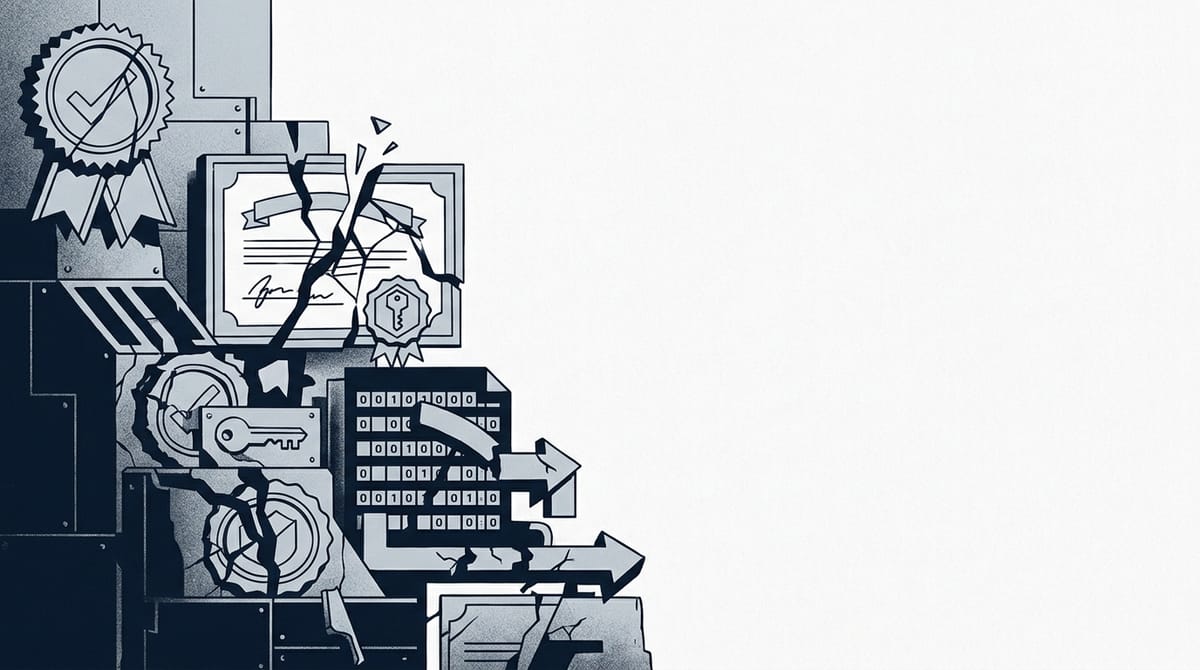
The next durable moat in AI may not be intelligence at all. It may be the ability to make trust feel ordinary again after a breach.
When OpenAI disclosed on April 10, 2026 that a compromised version of Axios had touched a GitHub Actions workflow used in its macOS app-signing process, the immediate facts mattered. The affected workflow had access to signing and notarization material for ChatGPT Desktop, Codex App, Codex CLI, and Atlas. OpenAI said it found no evidence of user-data exposure, no evidence its products were altered, and no evidence the signing certificate had actually been exfiltrated. Still, it chose to rotate the certificate, publish fresh builds, and set a May 8, 2026 cutoff after which older macOS versions would lose updates or stop functioning. That is good incident response. It is also a signal about where platform power is moving.
The breach matters less than the remediation choreography
Most coverage of supply chain compromises still treats them as binary events. Was code stolen. Was malware shipped. Was user data exposed. Those are necessary questions, but they are no longer sufficient when the product surface is an AI operating layer developers rely on every day.
The more strategic question is this: who can re-establish default trust fastest after a break in the chain.
That sounds subtle, but it is not. A developer ecosystem does not reroute only because a company was breached. It reroutes when the path of least resistance stops feeling safe. Trust in AI tooling is now operational, not abstract. It lives in update channels, signing flows, package hygiene, in-app upgrade paths, notarization relationships, and the speed with which an ecosystem can be told, with evidence, that the default route is still usable.
OpenAI’s response was built around exactly that operational layer. It rotated certificates, published minimum safe versions, worked with Apple to block new notarization using the old certificate, and explained why it was delaying full revocation long enough to avoid breaking legitimate users. That 30-day remediation window is not just customer support. It is governance over installed trust.
The real moat is the ability to reset the default
This is where AI tooling starts to look less like software distribution and more like private infrastructure management.
If your company controls the assistant, the desktop application, the CLI, the update mechanism, the authentication layer, and the relationship with the operating system vendor, then incident response becomes a kind of rulemaking. You are no longer only fixing a breach. You are deciding how quickly users must migrate, what versions count as legitimate, which warning paths users will see, and how much friction an ecosystem must absorb to stay inside your lane.
The old language for this was security hygiene. The newer and more useful language is routing power.
A platform with deep distribution can survive a compromise because it can instruct the ecosystem back into alignment. A weaker vendor facing the same class of incident may have technically similar facts and materially different outcomes. Not because the exploit was worse, but because it lacks the authority surface needed to restore trust at speed.
That is why the supply chain question in AI is not only whether dependencies are secure. It is whether trust repair is centralized.
Security is becoming a distribution contest
This is not unique to OpenAI, and that is exactly the point.
As AI products move from curiosity to workflow dependency, the winners will not simply be the models that perform best on benchmarks. They will be the companies that can make themselves feel like the safest default after something goes wrong. Safety here does not mean perfect technical prevention. It means credible operational recovery.
That changes the competitive landscape. It rewards vendors with direct user relationships, signed clients, managed update channels, and the institutional maturity to speak clearly during a crisis. It punishes fragmented toolchains whose users are spread across mirrors, wrappers, forks, and community-maintained install paths. In other words, the security layer starts reinforcing the distribution layer.
This is the same pattern hiding inside other parts of AI. In media strategy, control over the room where interpretation happens becomes a strategic asset. In procurement, control over compliance pathways becomes one too. In developer tooling, control over the channel where legitimacy gets restored becomes another. The common mechanism is not persuasion. It is default-setting.
Once that clicks, the incident reads differently. The compromised dependency matters. The floating GitHub Actions tag matters. The absence of a configured minimumReleaseAge matters. But the most durable consequence may be that supply chain trust is being absorbed into platform governance, where the capacity to reassure and reroute users becomes part of competitive advantage.
The quiet consolidation happens after the apology
There is a sentence hidden inside stories like this that the industry does not say out loud: every major incident teaches developers which institutions can carry operational fear on their behalf.
That is a power transfer.
When a vendor says update here, trust this build, ignore third-party installers, use these exact versions, and keep moving, it is not just offering guidance. It is exercising authority over the edge between doubt and routine. That edge is where platforms harden.
The next fights in AI supply chains will not be won only by whoever prevents compromise. They will be won by whoever can restore ordinary behavior before uncertainty has time to decentralize the ecosystem.
That is why the real asset is not just a secure stack. It is a trusted recovery path.
And once trust repair becomes infrastructure, every incident stops being only a security failure and starts becoming a referendum on who gets to remain the default administrator of everyone else's certainty.
Sources
- https://openai.com/index/axios-developer-tool-compromise
- https://openai.com/academy/responsible-and-safe-use
- https://unctad.org/publication/creative-economy-outlook-2024
- https://www.oecd.org/en/topics/artificial-intelligence.html
Related reading
- For the narrative-control side of this same pattern: The Broadcast Booth as Battlefield: How OpenAI Bought the Room Where AI Gets Discussed
- For how the same incentives hit workers and markets downstream: How AI Is Repricing Africa’s Creative Economy