The Next Academic Gatekeeper May Not Be a Journal Editor
The important shift is not that AI is entering research workflows. It is that the workflow itself is becoming a site of governance.

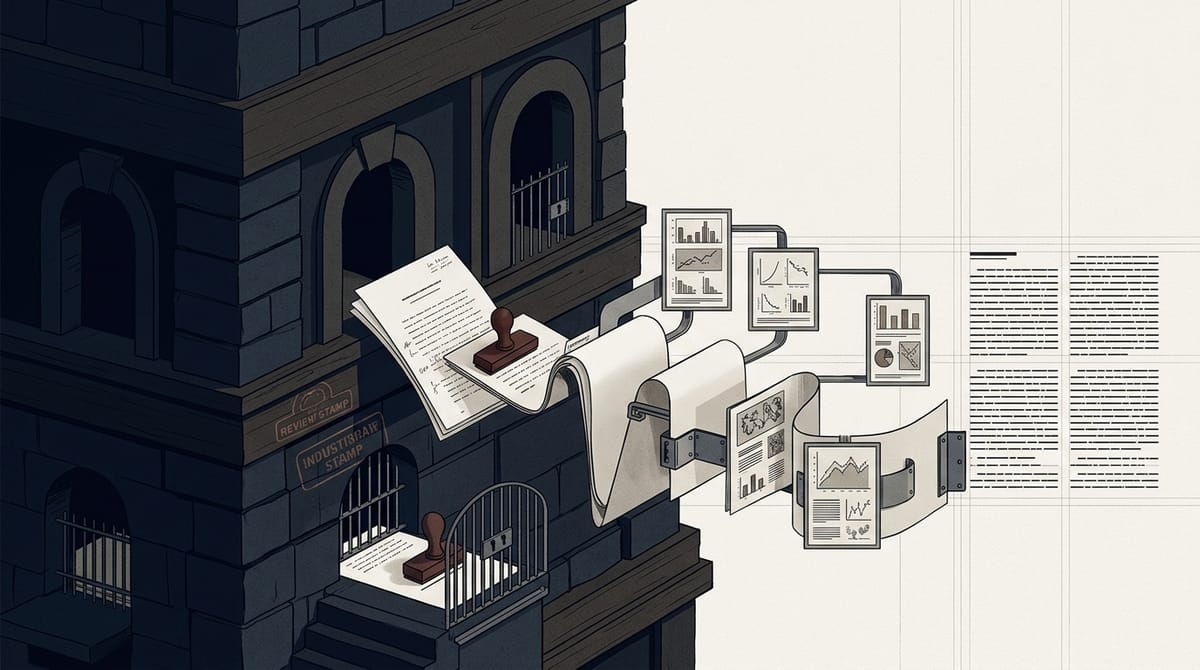
The next academic gatekeeper may not reject your paper. It may decide, long before review, whether your work looks legible enough to deserve attention at all.
In an April 8 announcement, Google Research introduced two experimental multi-agent systems aimed at the academic workflow itself. One, PaperVizAgent, is built to turn manuscript text and figure captions into publication-ready diagrams and plots. The other, ScholarPeer, is designed to emulate a senior reviewer through live literature search, baseline hunting, and multi-aspect technical verification. Google frames them as assistants that reduce administrative overhead. That is true as far as it goes. But the more important shift is that academic judgment is beginning to be reorganized as workflow infrastructure.
The workflow is where authority gets smuggled in
Academic publishing has always claimed that legitimacy lives in institutions: journals, conference committees, editors, reviewers, and citation networks. What AI agents change is not the formal chain of authority at the end. They change the governed process that determines what reaches that chain in the first place.
PaperVizAgent is a good example. According to Google’s description, the system coordinates a retriever, planner, stylist, visualizer, and critic. It takes method text and a figure caption, gathers references, synthesizes academic style guidance, renders an image or statistical plot, and then loops through iterative critique until the output is both aesthetically acceptable and technically faithful. That sounds like production help. It is also a quiet intervention into what counts as communicatively legible science.
A figure is not decoration. It is compression, emphasis, and persuasion. When the figure pipeline becomes tool-mediated, the platform starts influencing how methods are made visible, which forms of explanation travel fastest, and which aesthetic conventions become normal. The paper still belongs to the author. The workflow increasingly belongs to the tool.
Peer review is becoming a platform surface
ScholarPeer pushes even closer to the institutional core. Google says the system uses live web-scale literature access, a sub-domain historian, an adversarial baseline scout, and a multi-aspect Q&A engine to generate highly critical, literature-grounded reviews. In plain language, that means the review process is being decomposed into retrieval, comparison, verification, and synthesis steps that can be orchestrated by a platform.
That matters because peer review has never only been about quality control. It is also a rationing system for attention, legitimacy, and career movement. Reviewer fatigue, conference submission growth, and uneven quality have all made that system brittle. AI tools will look like relief. Some of them may be. But relief is not neutral when it arrives as infrastructure.
The moment a workflow tool becomes the standard way to generate a review draft, check omitted baselines, or structure criticism, it begins shaping what criticism looks like. It can widen access to competent review. It can also standardize judgment around whatever forms of evidence, style, and risk sensitivity the tool happens to privilege.
The hidden move is this: gatekeeping does not disappear when it gets automated. It migrates upstream.
Academic legitimacy is starting to depend on tool design
This is where the issue stops being about convenience.
If researchers begin relying on agents to produce clearer figures, stronger reviewer simulations, and faster literature-grounded critiques, then publication advantage will no longer come only from having the best idea or the best argument. It will also come from access to the best workflow stack. That means academic inequality can start to look less like prestige bias alone and more like infrastructure asymmetry.
Researchers at well-resourced labs will be able to iterate papers faster, pre-empt reviewer objections earlier, and present findings in more legible forms. Smaller institutions, independent researchers, and scholars in resource-constrained settings may face a new burden: not just doing the work, but doing it without the platform layer that increasingly defines what polished work looks like.
We have seen this pattern before. In developer tooling, trust repair becomes platform power because the workflow itself starts deciding who remains usable after disruption. In academic publishing, legitimacy may increasingly belong to whoever governs the tools that shape submission quality before editors and reviewers ever weigh in.
The real governance question comes after the prototype
Google is explicit that these tools are experimental and not production-ready. That disclaimer matters. But disclaimers do not cancel trajectory.
The deeper question is not whether PaperVizAgent or ScholarPeer are perfect today. It is whether academic institutions are prepared for a world in which core scholarly functions become partially outsourced to proprietary workflow systems whose defaults are set elsewhere.
That is a governance problem before it is a product problem.
Who audits the review heuristics. Who decides whether a figure-generation style is clarifying or distorting. Who benefits if academic quality starts being inferred through compliance with tool-shaped norms. And who gets left outside if “submission readiness” becomes inseparable from access to AI-mediated workflow infrastructure.
The next academic gatekeeper may still wear a human face at the end of the process. But the more consequential gate is likely to be the invisible workflow that taught the paper how to look convincing before any human ever had the chance to doubt it.
Sources
- https://research.google/blog/improving-the-academic-workflow-introducing-two-ai-agents-for-better-figures-and-peer-review/
- https://research.google/blog/evaluating-alignment-of-behavioral-dispositions-in-llms/
- https://www.oecd.org/en/topics/artificial-intelligence.html
- https://unctad.org/publication/creative-economy-outlook-2024
Related reading
- For a related piece that pushes the argument from another angle: The Next AI Supply Chain Fight Is About Who Gets Trusted Fast
- For the narrative-control side of this same pattern: The Broadcast Booth as Battlefield: How OpenAI Bought the Room Where AI Gets Discussed